
Case study · CureMD · 2024–2026
How CureMD grew organic inbound leads 25% year over year
I led content strategy and organic search execution within CureMD’s growth team. My work focused on increasing the organic SEO (Google) and AI search (GEO) visibility by matching the site to how healthcare practices actually searched for EHR, RCM, practice management, patient engagement and newer AI products.

At a glance
- Company: CureMD — EHR, practice management, RCM, patient engagement and AI products for US outpatient practices
- Market: US ambulatory providers, from solo clinicians to multi-site groups
- My role: Content strategy, organic search and execution within the growth team; supporting content across email, paid, social, video and product launches
- Primary result: Organic inbound leads increased from ~170/month in 2024 to ~212/month in 2025 (+25% YoY)
The situation
CureMD sells EHR, practice management, RCM, patient engagement, credentialing and newer AI products to US outpatient practices. It competes with large healthcare software vendors at one end of the market and small to medium size vendors at the other.
The broad category terms were difficult and often crowded with review sites and aggregators like G2, Capterra, etc. The more useful pattern was visible in the way practices made the search more specific. For example, a cardiologist was rarely just looking for an EHR. They were looking for an EHR that handled cardiology workflows, or billing support for cardiology, or software that made sense for a small practice in a particular state.
That pattern gave us a large set of smaller, commercially relevant searches that generic product pages were not covering well.
What I owned
My primary responsibility was content strategy and organic search: identifying opportunities, deciding what we should build, producing and publishing the content, on-page SEO, and tracking performance.
I worked inside the broader growth team and also developed content used across email, PPC, social, video and product launches. Link acquisition was handled by a dedicated link builder working alongside me. I was also a part of digital PR supporting launches and priority pages. Paid media, outbound and lead-vendor channels had separate owners.
The search pattern
Search demand repeated across four main dimensions: specialty × service line × practice size × geography. We used that pattern to build a partly programmatic SEO structure where each useful combination represented a different buyer situation.
The same structure kept appearing in the data: cardiology EHR, cardiology medical billing, small-practice EHR, medical billing in Florida, credentialing for nurse practitioners, and so on. Individually, many of these queries were not large. Together, they covered a meaningful amount of high-intent demand.
We continued expanding the structure as the pages began ranking and contributing leads.
What we built
The architecture eventually included roughly 35 specialty EHR pages, around 24 specialty billing and RCM pages, practice-size pages, state-level billing pages, and a separate credentialing cluster.
Each page type had a framework, and the content was adapted to the buyer behind the query. Specialty billing pages focused on the billing problems and outcomes that mattered to that specialty. Specialty EHR pages focused on the workflows and features that were actually relevant to those clinicians. Where we had them, we added specialty-specific testimonials, guides and FAQs.
Priority commercial pages also received ongoing link acquisition and digital PR support. The more competitive terms generally needed stronger off-site authority as well as good on-page work.
Most of the architecture focused on specific, high-intent demand. We also chose a small number of broader commercial queries where the traffic and lead potential justified competing for the top positions.
What happened
These are internal annual averages. Using annual averages helped smooth the normal seasonal dips around Thanksgiving, Christmas and the summer period. The figures refer to website inbound attributed to organic search; paid, outbound, events and lead vendors were tracked separately.
One page became a consistent lead source
As of August 2026, Semrush still showed CureMD at position #1-2 in the US for “emr systems,” a term it estimated at 18.1K monthly searches. The current ranking is third-party evidence of where the page sits today; the 20–30 monthly lead figure comes from internal reporting during my tenure.
Ranking itself wasn’t the outcome. The page was useful because it connected a large commercial query to an asset that could actually generate sales conversations.
The search footprint today
The program continued after I left CureMD, so I would not attribute everything the site is doing today to work I personally did. The current numbers are still useful for showing how the search footprint has held up.
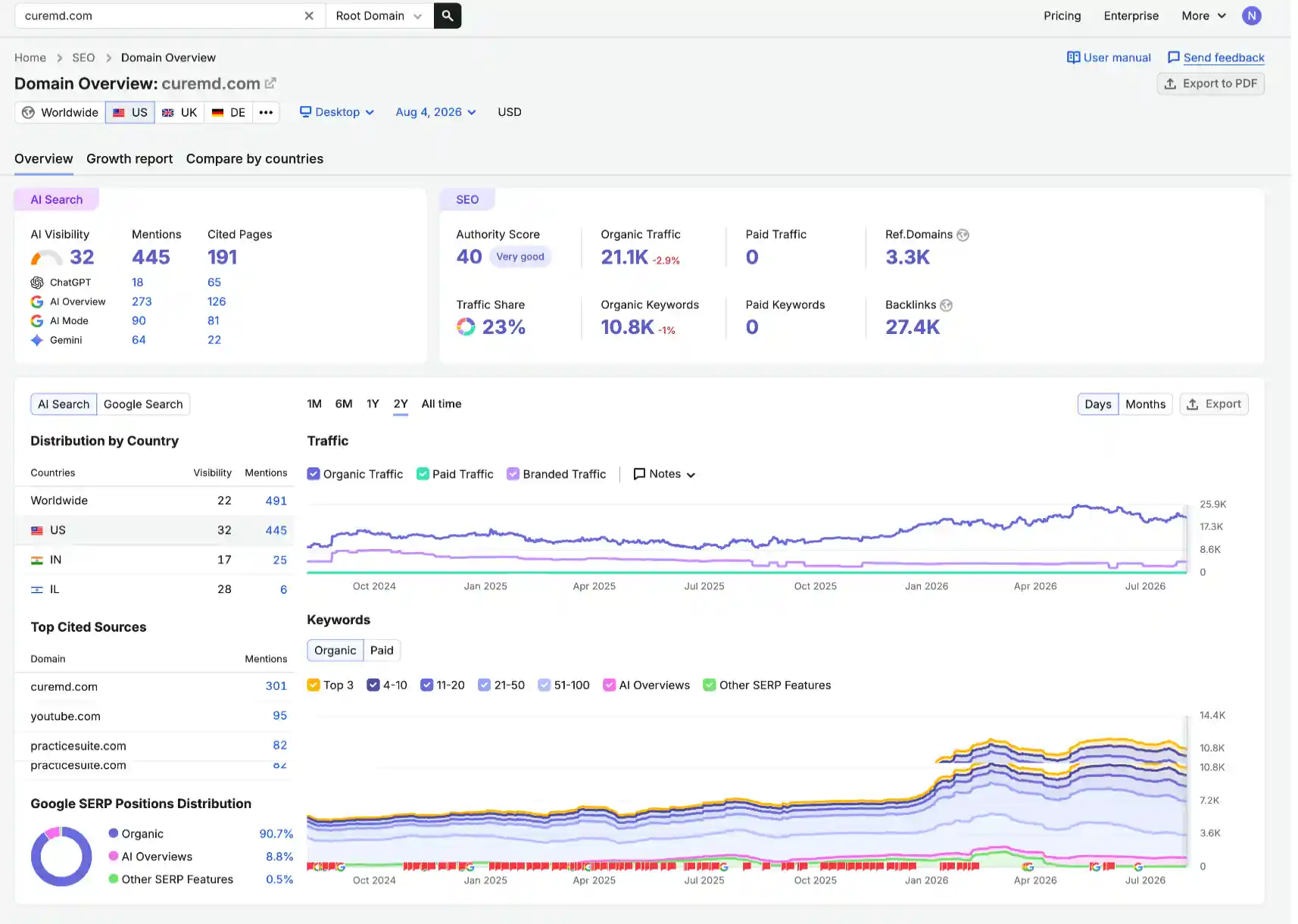
In August 2026, Semrush estimated 10.8K ranking organic keywords and 21.1K monthly organic visits for curemd.com in the US. It also showed a 23% traffic share against the competitive set used in the report.
Those are third-party estimates, and I use them as a current snapshot rather than as a claim about my individual contribution.
How the same footprint shows up in AI search
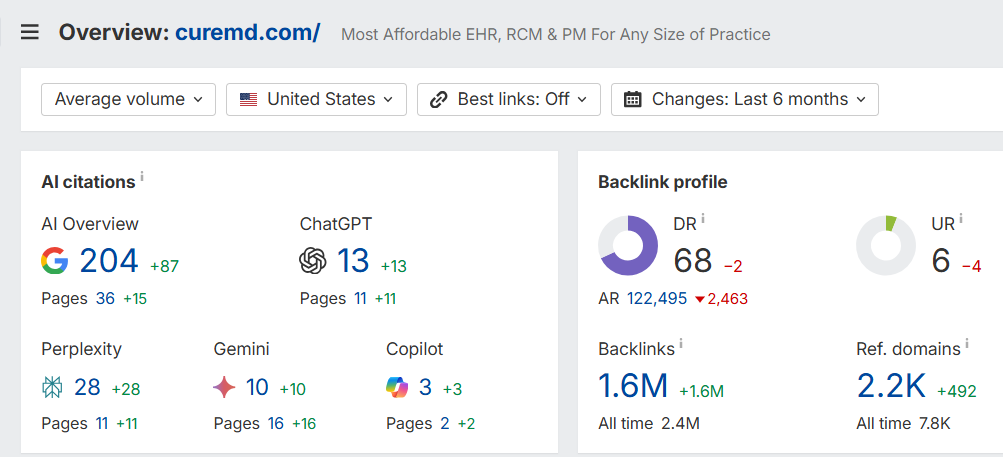
AI search was not a separately reported acquisition program when most of this architecture was built. Today, third-party tools show CureMD being cited across Google’s AI surfaces and the major LLMs.
I wouldn’t attribute CureMD’s current AI visibility to one person or one initiative. The useful observation is that many of the characteristics we deliberately built for organic search — specific pages for specific buyer questions, explicit answers, broad topical coverage and off-site authority — are also present in the pages AI systems now cite. LLMs also pull from search index, and traditional rankings have been shown to influence AI answers.
A lot of the AI-search visibility was hard to attribute cleanly to leads. The closest proxy we had was the slight increase in direct traffic, along with what people told our SDRs when they followed up.
My best guess is that some people researched software in LLMs, saw CureMD mentioned or recommended, and then searched the brand or came to the site directly. Our SDRs would ask leads how they heard about us. Leads from direct traffic, together with those voluntary disclosures, amounted to roughly 5% of the monthly lead volume we were getting from organic search. ChatGPT was the biggest LLM source we heard about.
Google’s AI Mode and AI Overview traffic was reported under organic search, so that estimate covers LLM-driven leads outside Google’s AI surfaces. I would treat the 5% as directional rather than a clean attribution number.
The practical takeaway for me was that a lot of the underlying work carried across both traditional and AI search: clear information architecture, pages built around specific buyer questions, explicit product and entity information, consistent messaging off-site, internal linking, topical depth and off-site authority. AI search adds another discovery layer, and it makes clear answers and external corroboration especially useful.
Broader growth work and newer AI products
My main responsibility was content and organic search, but the role gave me exposure to the wider growth function and to product launches outside the established EHR and RCM categories.
I supported CureMD’s AI scribe and its AI Patient Contact Center / AI voice agent with launch and campaign content. For both the AI Scribe and the AI Patient Contact Center, I was a key part of making the overview launch content and video that CureMD published on its product pages and YouTube, and I also worked on content around the PR launch. The same work fed into email, paid campaigns and social.
The AI scribe also gave us a useful product lesson. It generated interest, but many prospects wanted it to work with the EHR they already used. Because it was CureMD-integrated at the time, some of that demand could not progress. Not one me, I suppose.
Other channels gave us useful context as well. Paid lead vendors became more expensive while lead quality stayed inconsistent, and PPC needed more spend than the return justified at the time. Those channels were owned by other people on the team, but I supported them with content and observed the strategy/performance alongside organic.
What I took from the work
The strongest search opportunities usually came from understanding how a practice described its situation, then building the page around that specific buying context.
Programmatic SEO was useful because the market had repeatable query patterns, but the pages still needed real differences in intent, messaging and proof. The same was true for broader category terms: we pursued them when the commercial value justified the competition.
The AI-search data also reinforced how difficult attribution can be. Visibility can be measured reasonably well; the path from an LLM recommendation to a lead is often less clean. Direct traffic, sales-team disclosures and organic reporting together gave us a directional view rather than a perfect one.
Sources and attribution
Lead figures are stated as approximate monthly averages. Current ranking, traffic and AI-visibility figures are third-party estimates from Semrush and Ahrefs, checked in August 2026. Current metrics are used as evidence of the site’s present footprint and are not attributed to a single contributor. A reference from CureMD’s US marketing team is available on request.