
Research · August 2026
What AI Scribe Does AI Recommend? I Analyzed 190 Answers to Find Out
I asked ChatGPT, Claude, Gemini, Perplexity, and Google's AI Overviews the 38 questions clinicians actually ask before buying an AI scribe. Then I traced every source, every brand mention, and every recommendation. This is what came back.

Somewhere right now, a physician is typing “best AI scribe for a small practice” into ChatGPT.
They’ll get a confident shortlist in about four seconds. So will the next physician who asks Claude. And the one after that. But here’s the thing I can now say with data: those three physicians will get three different shortlists, built from evidence that is overwhelmingly written by the vendors themselves.
I spent the last two weeks running a structured study on this. 38 buyer questions. 5 AI platforms. 190 captured answers, 1,108 source citations, 399 unique URLs. I then traced who actually benefits when each vendor’s page gets cited.
Some of what I found genuinely surprised me. The most-cited page in the entire category got its publisher recommended zero times — and got a competitor recommended thirteen times. The market leader by brand mentions had its own website cited exactly once in 190 answers. And review sites — G2, KLAS Research, Capterra — were cited a combined two times.
If you’re a founder or a senior leader at an AI scribe company, this article will tell you where you stand in AI answers, how good your generative engine optimization (GEO) is, why, and what I’d try first to improve the visibility, and leads from AI models.
(Full method and limitations at the bottom. All data tables are downloadable.)
Contents
- Three words that get confused: cited, mentioned, recommended
- How I ran the study
- Finding 1: Five platforms, five different answers — and five different personalities
- Finding 2: Getting mentioned and getting cited are two separate games
- Finding 3: 79% of the “evidence” is vendor marketing
- Finding 4: Your listicle gets cited. Someone else gets recommended.
- Finding 5: The full list — every vendor AI cites and rarely mentions
- Finding 6: Specialty questions are a different landscape entirely
- Finding 7: The SEO layer underneath all of this
- Finding 8: Compliance questions are an empty room
- What I’d try first if I wanted to increase the AI search visibility of an AI scribe company
- Improve your Google and AI Search visibility
- Limitations and method
Three words that get confused: cited, mentioned, recommended
Almost every conversation I have about AI visibility mixes these up. They’re three different events, they’re measured differently, and, this is the important part, winning one has almost nothing to do with winning the others.
| Term | What it means | Where you see it | Who tracks it |
|---|---|---|---|
| Cited | The AI pulled your URL as a source for its answer | The source panel, footnotes, or link chips | Almost nobody |
| Mentioned | Your brand name appears somewhere in the answer text | The body of the answer | Most “AI visibility” tools stop here |
| Recommended | The AI puts you at or near the top of its actual advice | The first names a buyer reads | Explicit recommendation by AI |
In simpler terms, consider this.
OmniMD published a page called “Best AI Medical Scribes in 2026: 15 Tools Reviewed by Expert.” That page was cited in 21 separate AI answers — more than any other URL in the study. OmniMD the brand was mentioned reasonably often, partly because it appears at #6 on its own list. But across every answer that cited an OmniMD page, OmniMD was recommended first exactly zero times.
Same company. Same query. Winning one game completely, losing another completely.
Hold onto that distinction. Every finding below depends on it.
How I ran the study
- 38 questions, phrased the way buyers phrase them, across six intents: open discovery, practice size, EHR integration, specialty, pricing, and trust/compliance.
- 5 platforms: ChatGPT, Claude, Gemini, Perplexity, Google AI Overviews. Same questions, clean sessions.
- 190 answers captured with full text and every citation — 1,108 citation placements across 399 URLs and 178 domains.
- Then: brand-name normalization across ~68 vendors, analyzed the patterns, fetched and hand-audited the 20 most-cited pages, and traced who got mentioned in every answer that cited each vendor’s site.
One constraint upfront: this is a single run. Treat the individual counts as a snapshot and the patterns — which repeat across platforms and intents — as the findings. Full limitations and method at the end.
Finding 1: Five platforms, five different answers — and five different personalities
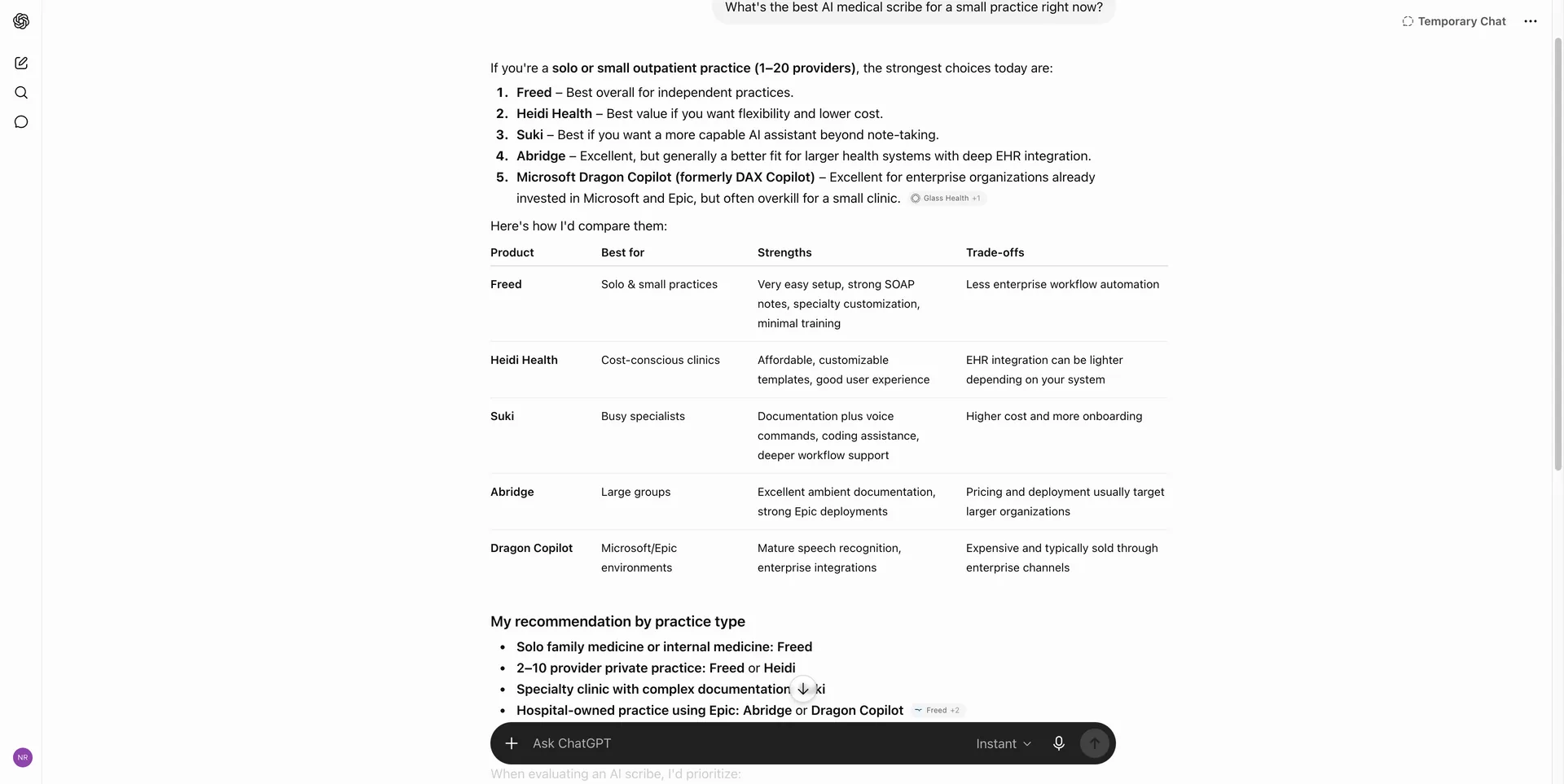
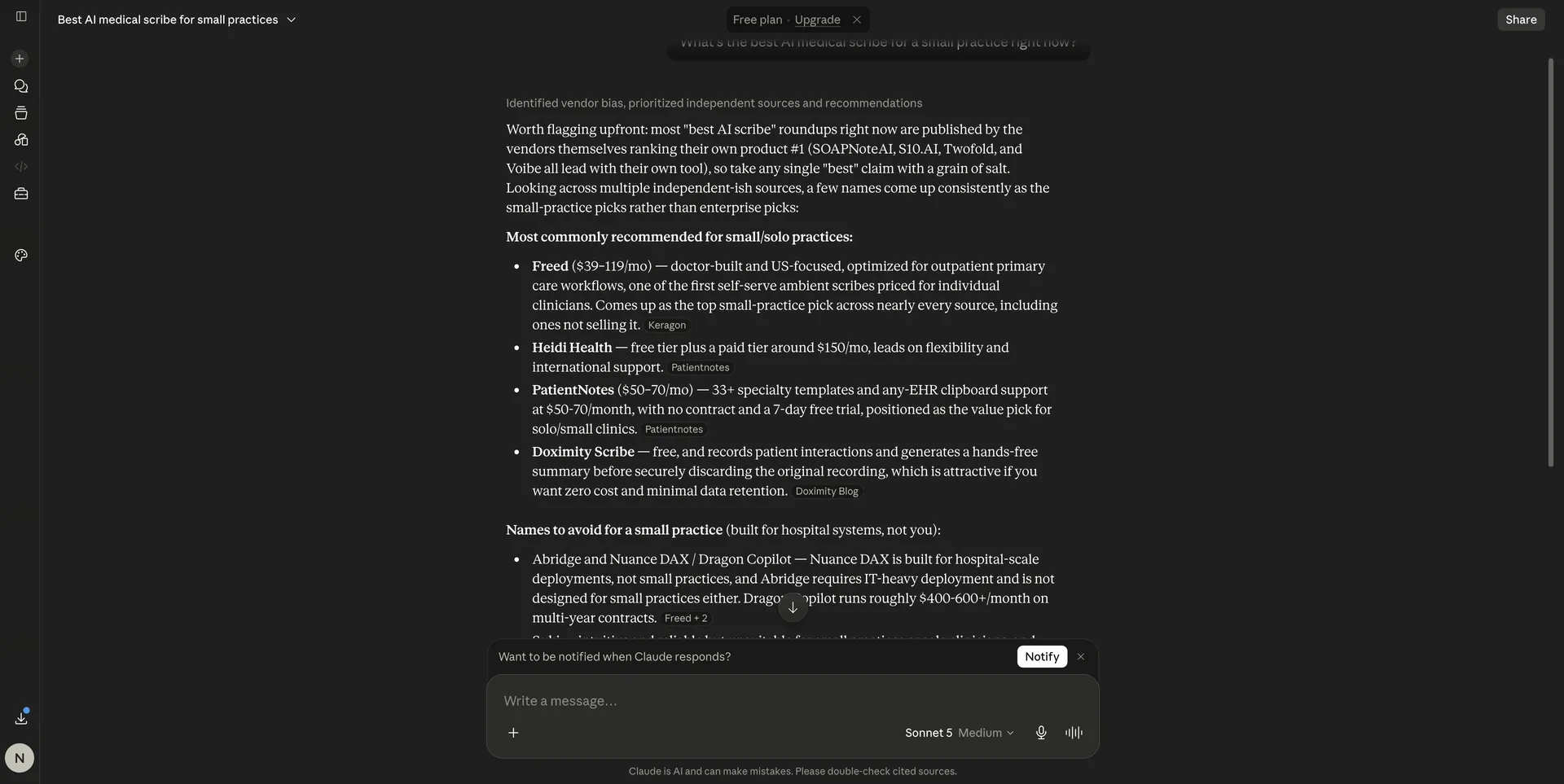
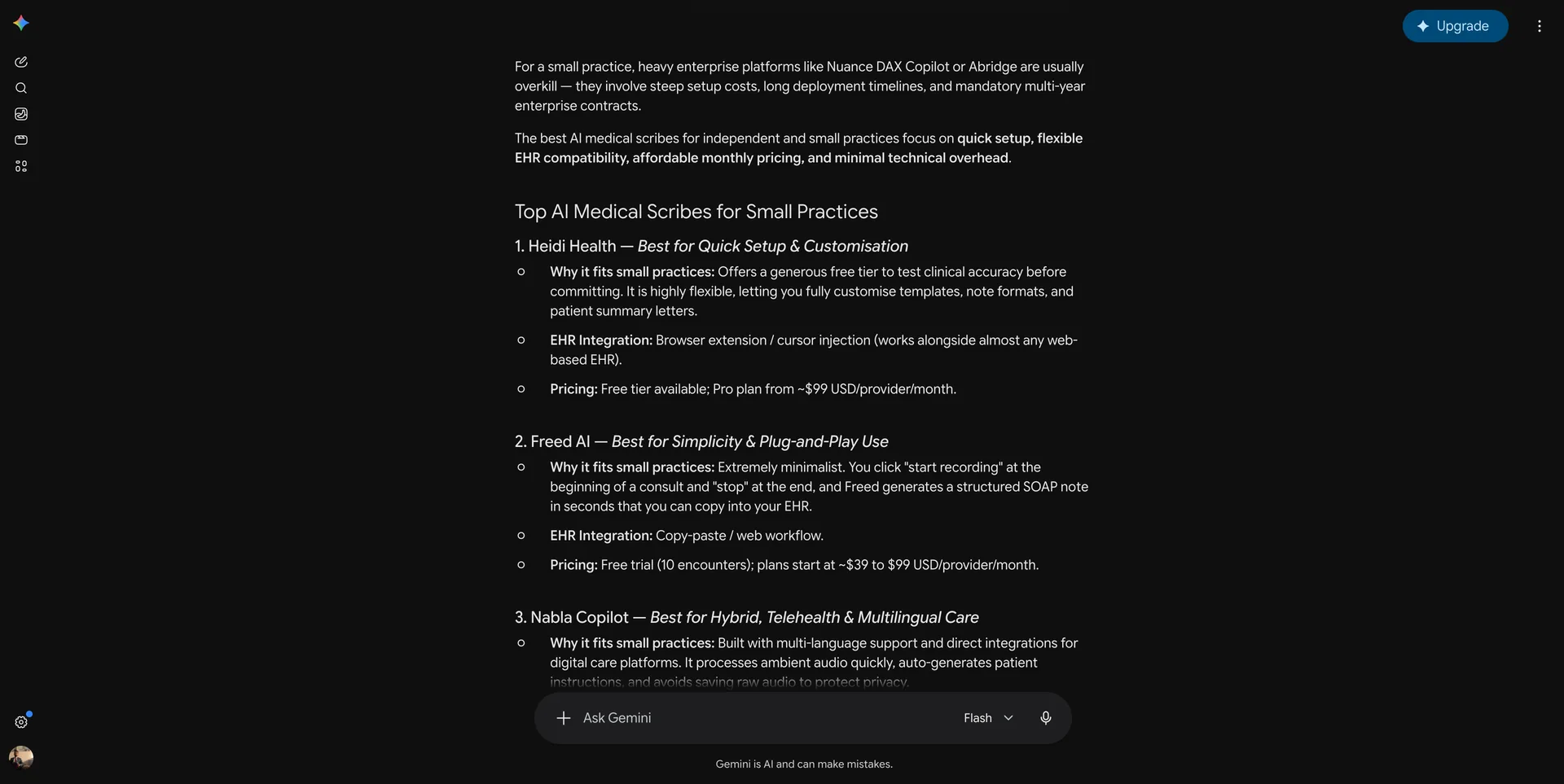
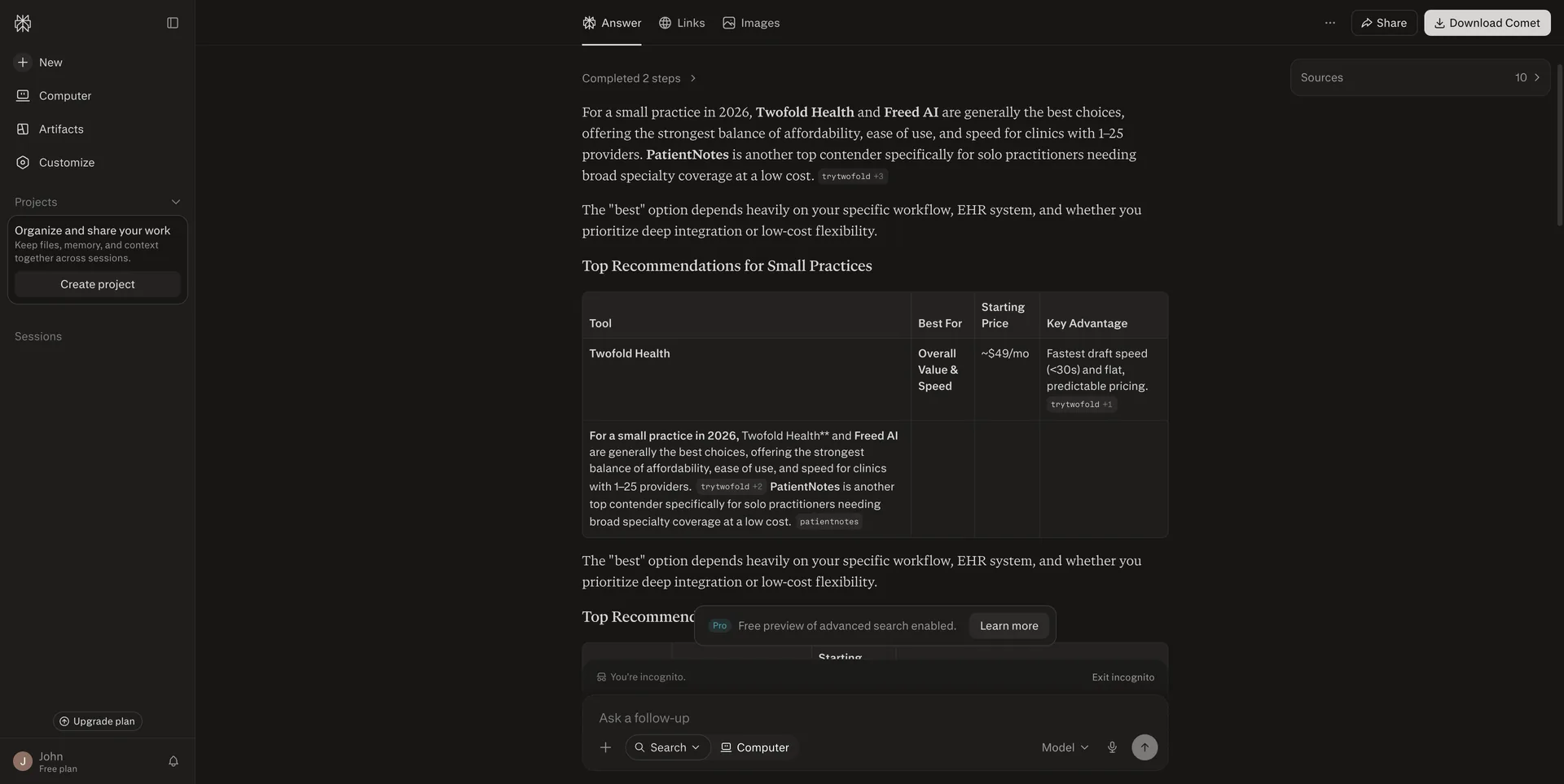
Across the 34 questions where at least three platforms gave a full ranked answer:
- Same brand named first on all platforms: 3 of 34.
- Identical top-three sets: 0 of 34.
- No brand at all common to every platform’s top three: 16 of 34.
- Average overlap between any two platforms’ top threes: 27%.
ChatGPT
Claude
Gemini
Perplexity
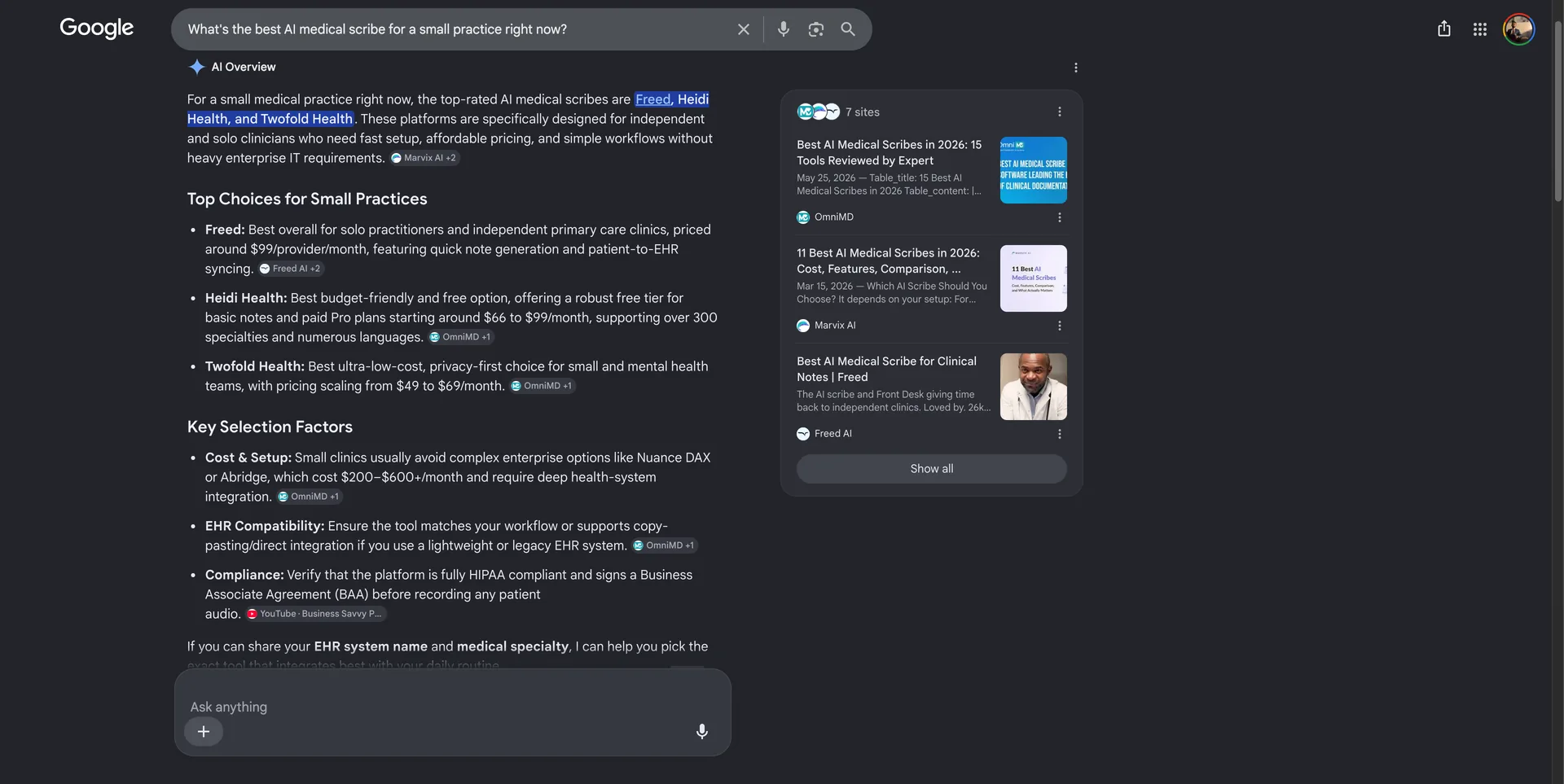
Google AI Overview
1 / 5
There is no single AI leaderboard for this category. There are five, and they barely agree.
But the disagreement isn’t random. Each platform has a personality — a consistent way it assembles an answer — and that personality decides what you can influence.
| Platform | Sources per cited answer | Behaves like | What moves it |
|---|---|---|---|
| Google AI Overviews | 19.9 | A synthesizer of the top-ranking pages, ~90% vendor sources, YouTube in the mix | Ranking in classic search |
| Claude | 10.9 | A heavy reader, 85% vendor sources, deep on a few pages | Being in the retrieved page set |
| Perplexity | 7.1 | A broad sampler across many domains | Breadth of indexed coverage |
| ChatGPT | 6.5 | The most diverse mix — the only platform citing Reddit (11 of 38 answers), WSJ, arXiv | Coverage beyond your own domain |
| Gemini | 1.0 | Answering from memory, barely citing anything | Brand knowledge baked into training |
That table explains a lot of the disagreement. Twofold shows up in 18 of 38 Perplexity answers and only 7 to 9 on each other platform — a retrieval-driven win that Gemini never sees. Gemini, citing roughly one source per answer, names DAX/Dragon Copilot first more than anything else, because that’s what it already believes. Claude leans toward S10.AI and Commure. OmniMD is weak across chat platforms but appears in 8 of the 12 AI Overviews captured.
So a single “AI visibility score” averages away the only actionable information you have. Perplexity and AI Overviews respond to what you publish and where it ranks. Gemini mostly responds to who talks about you elsewhere, over years. Those need different budgets.
Finding 2: Getting mentioned and getting cited are two separate games
I counted two things for every vendor. Mentions come from the 114 answers where I captured complete answer text — Claude, Gemini, and Perplexity, 38 questions each. Citations come from all 190 answers, across 5 models.
| Brand | Mentioned (of 114 answers) | Own site cited (of 190 answers) |
|---|---|---|
| Freed | 81 (71%) | 37 |
| DAX / Dragon Copilot | 58 (51%) | 1 |
| DeepScribe | 52 | 18 |
| Abridge | 52 | 3 |
| Heidi | 52 | 5 |
| Suki | 40 | 1 |
| DeepCura | 37 | 37 |
| Nabla | 34 | 2 |
| Twofold | 34 | 24 |
| Ambience | 14 | 1 |
Microsoft’s DAX is named in half of all answers, and its own website was used as evidence once. Suki: 40 mentions, one citation. Abridge, Heidi, Nabla, Ambience — same pattern.
My best guess is that these brands are memory-visible. The models learned them during training — press coverage, KLAS awards, funding rounds — and now name them from memory. Nothing on their own websites is participating.
My first theory was crawler blocking, so I checked robots.txt and llms.txt for the five biggest against GPTBot, OAI-SearchBot, ClaudeBot, and PerplexityBot. All open. Abridge’s robots.txt actually allow-lists the AI crawlers by name. As far as I can tell nobody in this category is blocking, and I’d expect the same across the long tail.
The difference is what those sites publish. I crawled their sitemaps: Abridge (540 URLs), Nabla (382), and Ambience (65) have no comparison content and no public pricing at all. Suki has a category guide with no named rivals. Microsoft documents licensing without dollar figures. Wide open to every crawler, offering nothing in the format that gets cited.
And memory is a comfortable position right up until it isn’t. You can’t steer it, segment it by intent, or defend it when a challenger’s comparison page becomes the retrieved evidence on the query that matters.
Freed is the only brand winning both games. Mentioned in 71% of answers, most-cited domain in the study, and when Freed’s site is cited, Freed lands in the top three 85% of the time. Hold that 85% — it’s the benchmark for the next two sections.
Finding 3: 79% of the “evidence” is vendor marketing
Of the 1,108 citation placements:
- 79.1% point to pages owned by AI scribe vendors.
- 52% point specifically to “best AI scribe” comparison listicles.
- I counted 127 distinct comparison URLs from 45 different vendors.
And the sources you’d expect to anchor a clinical software category:
- G2: zero citations.
- KLAS: zero — though answers mention KLAS scores 17 times, always secondhand through vendor blogs quoting them. Probably because of paywalls. Brands pay for the reports and publish them on their sites.
- Capterra: two. Press: ~2.5% of placements. Academic: ~2%.
The independent review layer does not exist inside AI answers. It’s vendors reviewing each other — Marvix reviews Commure, SOAP Note Buddy reviews Commure, Commure reviews Heidi — with the engines citing that mesh as evidence.
It gets a bit weirder. Directory sites with no visible editorial team. Software-development agency blogs — Peerbits, Hostalky, Folio3 — publishing scribe roundups for their own lead gen. And ChatGPT cited a thread from r/Twofold, Twofold’s own subreddit, in five separate pricing answers, alongside an organic r/medicine thread where a clinician compared the tools they’d actually used. A vendor-run thread and a real physician thread, same evidence pool, same weight.
Claude was smart. It could see the problem. Twice it opened an answer warning that most “best AI scribe” roundups are published by vendors ranking their own product first — then built its answer from those exact pages. In one of them, the first brand named appears inside the warning, as the example of self-ranking. Worth remembering the next time a tracking tool counts that as a mention win.
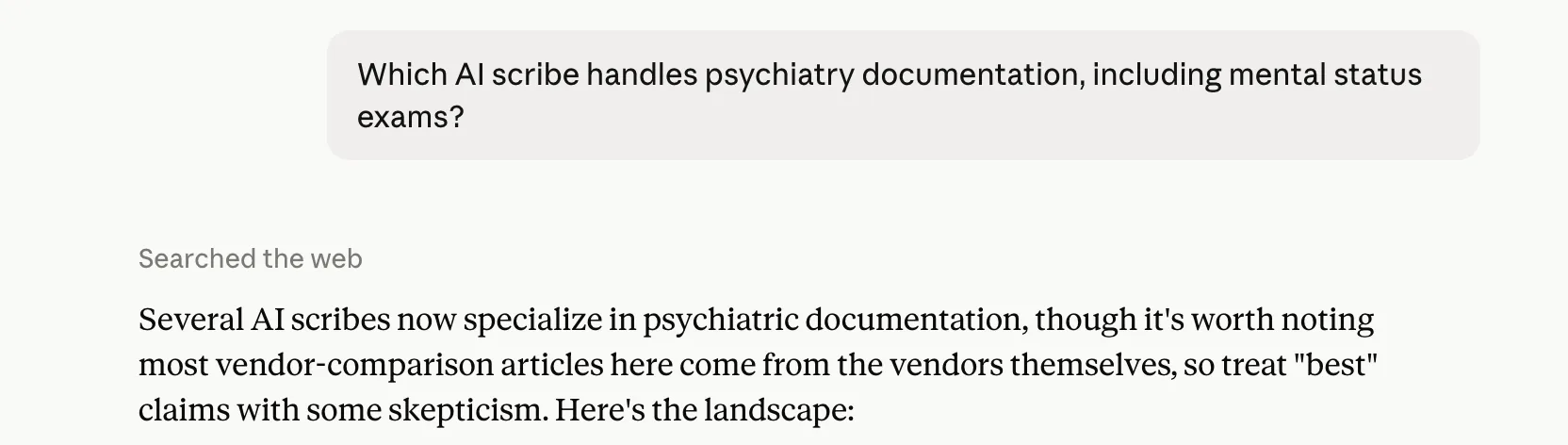
Claude
Finding 4: Your listicle gets cited. Someone else gets recommended.
If you’ve talked to a healthcare marketing agency or read a AI search/GEO guide in the past year, you’ve heard the play: publish comparison listicles, because listicles are what LLMs cite, and citations get you into AI answers.
The first two parts are true. My data and previous experience confirms them emphatically. It’s the third part — the part everyone assumes follows — that breaks.
So I measured it directly. For every vendor, I pulled the answers that cited that vendor’s own website, then checked what happened to the vendor’s brand inside those same answers.
Answers that cited each vendor’s own site (of the 126 answers with full text captured):
| Vendor | Answers citing their own site | …where they made the top 3 | …where their brand went unmentioned entirely |
|---|---|---|---|
| OmniMD | 24 | 2 | 9 (38%) |
| Marvix | 13 | 2 | 4 (31%) |
| Glass Health | 12 | 1 | 4 (33%) |
| Lucas Health | 9 | 2 | 2 (22%) |
| SOAPNoteAI | 9 | 3 | 5 (56%) |
| Keragon | 9 | 4 | 2 (22%) |
| OrbDoc | 8 | 1 | 1 (12%) |
| Vera Health | 7 | 0 | 3 (43%) |
| Doximity Scribe | 6 | 0 | 3 (50%) |
| River Records | 6 | 0 | 5 (83%) |
| Scribing.io | 6 | 1 | 5 (83%) |
| Pabau | 5 | 0 | 2 (40%) |
| VoiceboxMD | 5 | 1 | 2 (40%) |
| Lime Health | 5 | 1 | 3 (60%) |
| Voibe | 4 | 0 | 2 (50%) |
| Praxis EMR AI | 4 | 0 | 0 |
| Freed (for contrast) | 27 | 23 | 0 |
Read the OmniMD row like this: 24 answers used OmniMD’s own pages as a source. OmniMD made the top three of the answer in 2 of them. And in 9 of them, the AI used OmniMD’s content and never mentioned OmniMD anywhere in the response.
River Records is the sharpest version — its content was the evidence in six answers and its brand appeared in one. Scribing.io the same. Doximity Scribe went unmentioned in half the answers built on its own pages.
Now the aggregate. 64 answers cited at least one of these challengers’ sites. A challenger made the top three in 42% of them. A training-memory brand — Freed, Abridge, DAX, Heidi, DeepScribe — made the top three in 84%. Freed alone was named first in 17 of those 64, meaning Freed took the top slot in roughly a quarter of the answers built on other companies’ content.
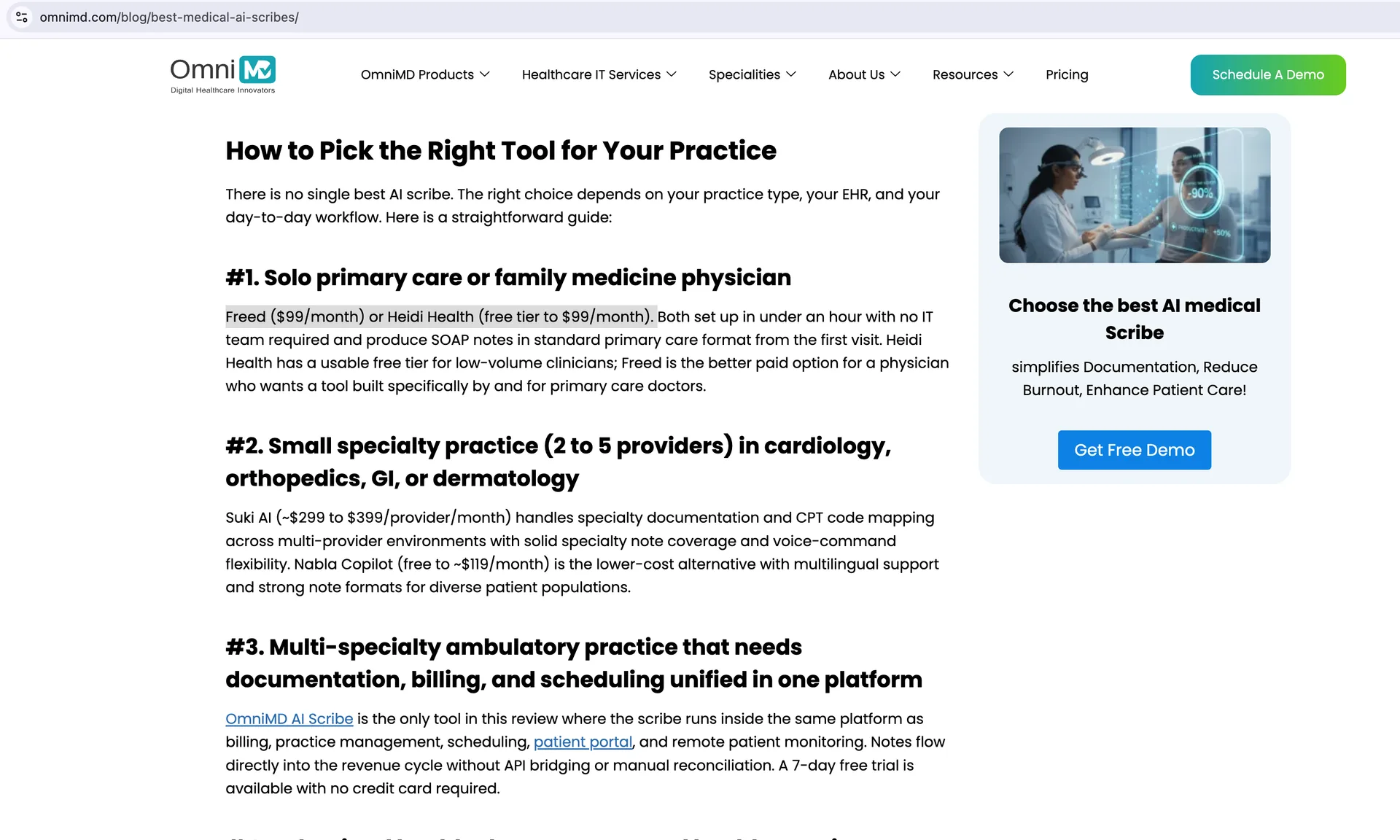
Opening recommendation
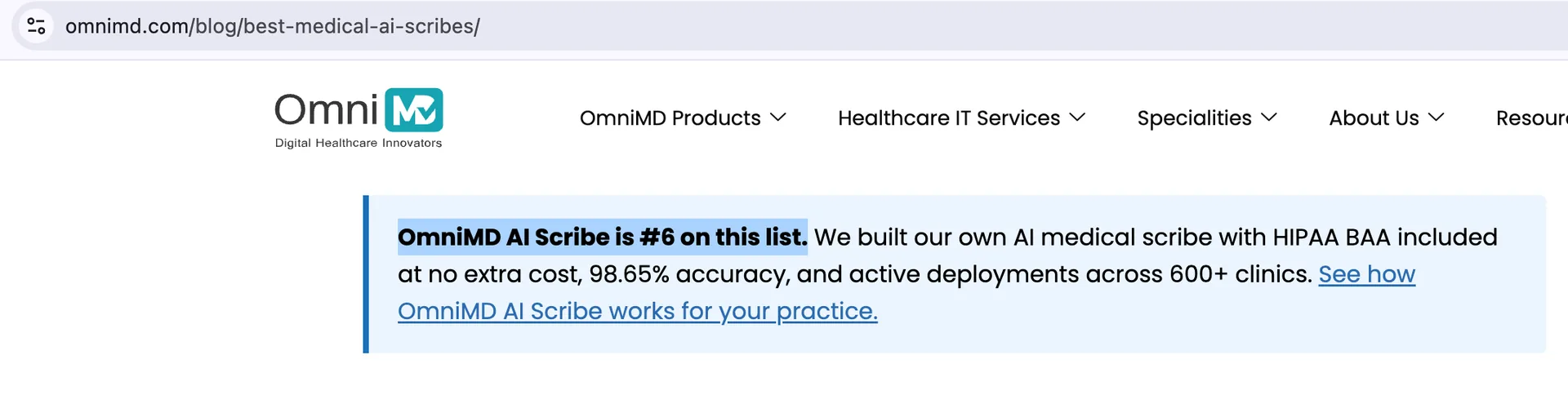
OmniMD at number six
1 / 2
Sit with OmniMD for a second, because it’s the whole finding in one company. OmniMD wrote the most-cited page in the category, and it’s the most rigorous one I audited: named clinical author, pricing verified against vendor pages, its own product honestly ranked #6 of 15. The page opens by telling readers to start with Freed or Heidi. Across the 24 answers citing OmniMD’s content, Freed was named first 13 times and OmniMD first never.
The pattern repeats with variations. Vera Health ranked Abridge #1 on its own comparison and stated plainly that Vera is an adjacent product; Abridge made the top three in six of the seven answers citing Vera’s page, and Vera made it in none. Keragon removed itself from its own list entirely; Freed won six of the nine answers citing Keragon.
The control case sits at the bottom of the table. 27 answers cited Freed’s own site. Freed made the top three in 23 of them and went unmentioned in zero.
So here’s the honest restatement of the playbook. Listicles buy the citation. It’s true. The recommendation gets decided by something else — how you position yourself on your own page, the entity strength of the brands you’re listing, and what exists about you beyond your own domain. Publishing the comparison gets your URL into the answer and routes the reader to whoever the model already trusts.
If you’re funding listicle production as an AI visibility strategy, that’s the question to put to whoever runs it: when our pages get cited, who gets recommended? Super important, this.
Finding 5: The wider roster — every vendor AI cites and rarely mentions in the answer
The table above covers vendors with enough citations to measure properly. Widen the lens and the pattern holds across the category.
Two more that belong on the list but sit outside that table:
- Wavo Health — cited in 7 answers, all of them ChatGPT, whose answer text was truncated in this run so its mention rate can’t be measured. Across the other platforms’ 114 answers, Wavo was mentioned once.
- BastionGPT — 4 answers citing its site, mentioned in all four, top three in one.
And below those sits a long tail of roughly 40 vendor domains cited at least once while the brand went essentially unnamed across the whole study: medicalscribe.app, transcribe.health, veroscribe.com, healos.ai, scribeable.ai, steerhealth.io, revmaxx.co, eluve.com, chartnote.com, rxnote.ai, healthorbit.ai, getprosper.ai, carepilot.com, clairemed.ai, psynopsis.ai, medsiteai.com, onechart.ai, Patient Square, SPRY, Skriber, ScribeMD, SOAP Note Buddy, Murphi, Dictum, and more. The full table with per-platform counts is with me. Happy to share it.
Every company in this section is already doing the hard part. Their content gets retrieved, on real buyer queries, across multiple platforms. The AI models treat their pages as trustworthy evidence. The gap sits entirely between being the evidence and being the recommendation.
If your company is anywhere in here: an AI platform cited your content this month and didn’t mention or recommend you.
Curious where your own site sits? Send me your domain and I’ll run a personalized check — which buyer questions you show up for, who shows up instead of you, and which sources those answers are built from. Get a snapshot →
Finding 6: Specialty questions shatter the leaderboard
Clinicians are most worried about AI scribes supporting their specialties. So, I asked nine questions asked about specific specialties, phrased with the workflow detail that makes each one its own documentation problem. “Pediatrics, where the parent does most of the talking.” “Orthopedic visits with detailed exam and range-of-motion findings.” “Urgent care where visits are fast and back to back.”
Here’s who got mentioned:
| Specialty | Claude | Gemini | Perplexity |
|---|---|---|---|
| Behavioral health / therapy | Mentalyc | Upheal | Twofold |
| Psychiatry (incl. MSE) | Psynopsis | DeepCura | Twofold |
| Pediatrics | Freed | Freed | DeepCura |
| Dermatology | ModMed Scribe | DeepCura | DeepCura |
| Orthopedics | DeepCura | DeepCura | Dictum |
| Physical therapy | Twofold | Twofold | ScribePT |
| Urgent care | Sunoh | DeepCura | Lucas Health |
| OB/GYN | Freed | Freed | Freed |
| Oncology | DeepScribe | DAX | DeepScribe |
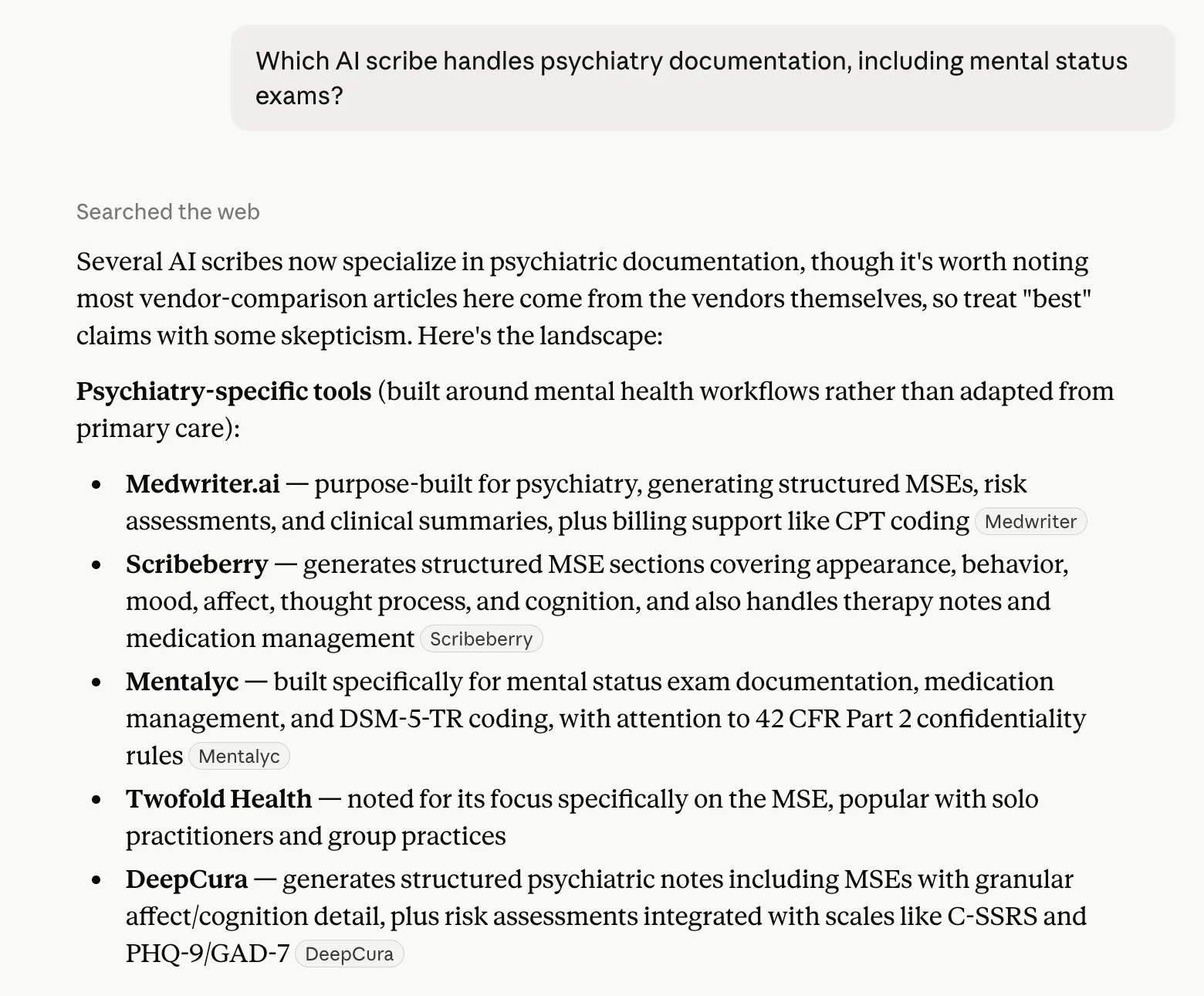
Claude
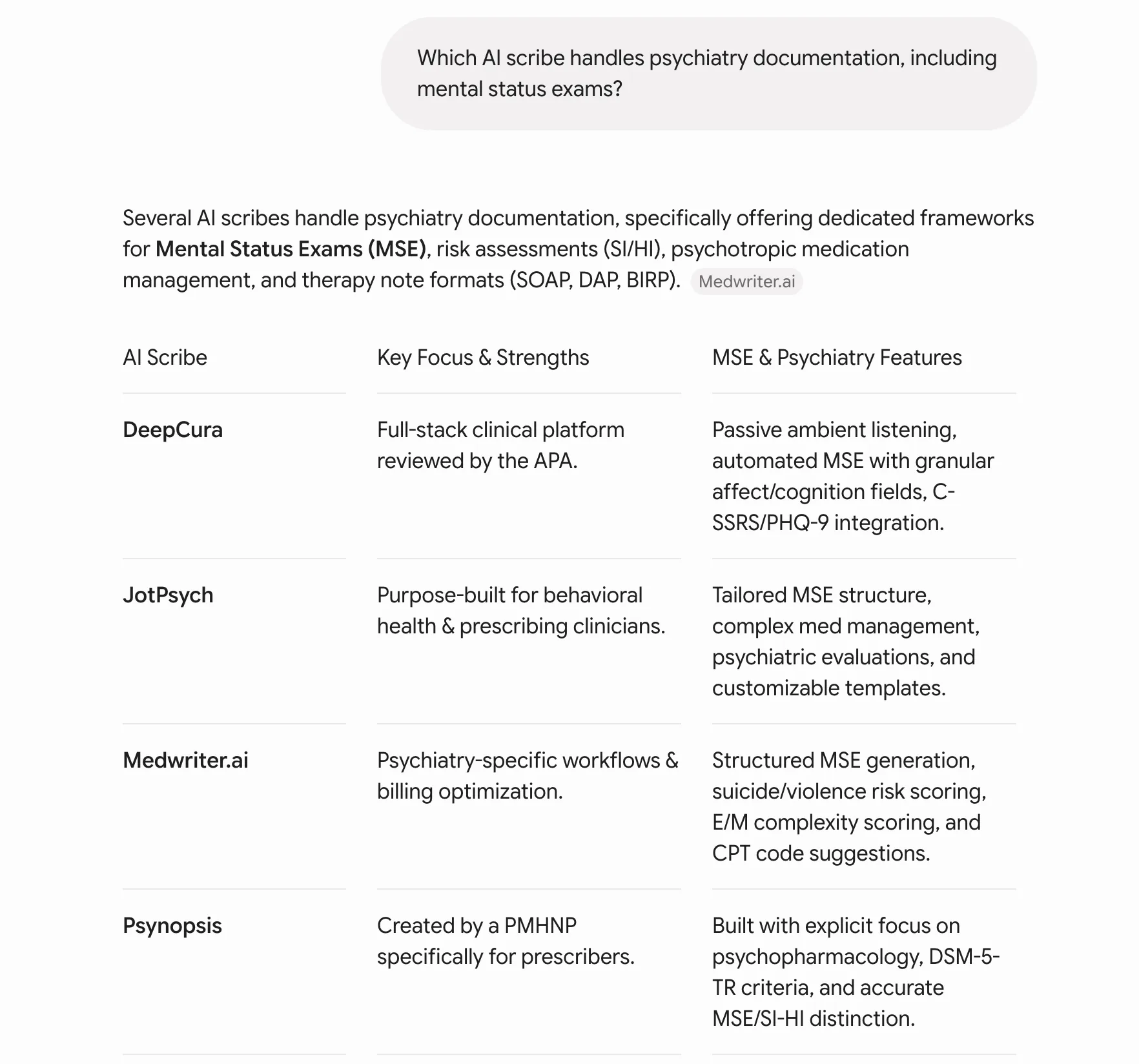
Gemini
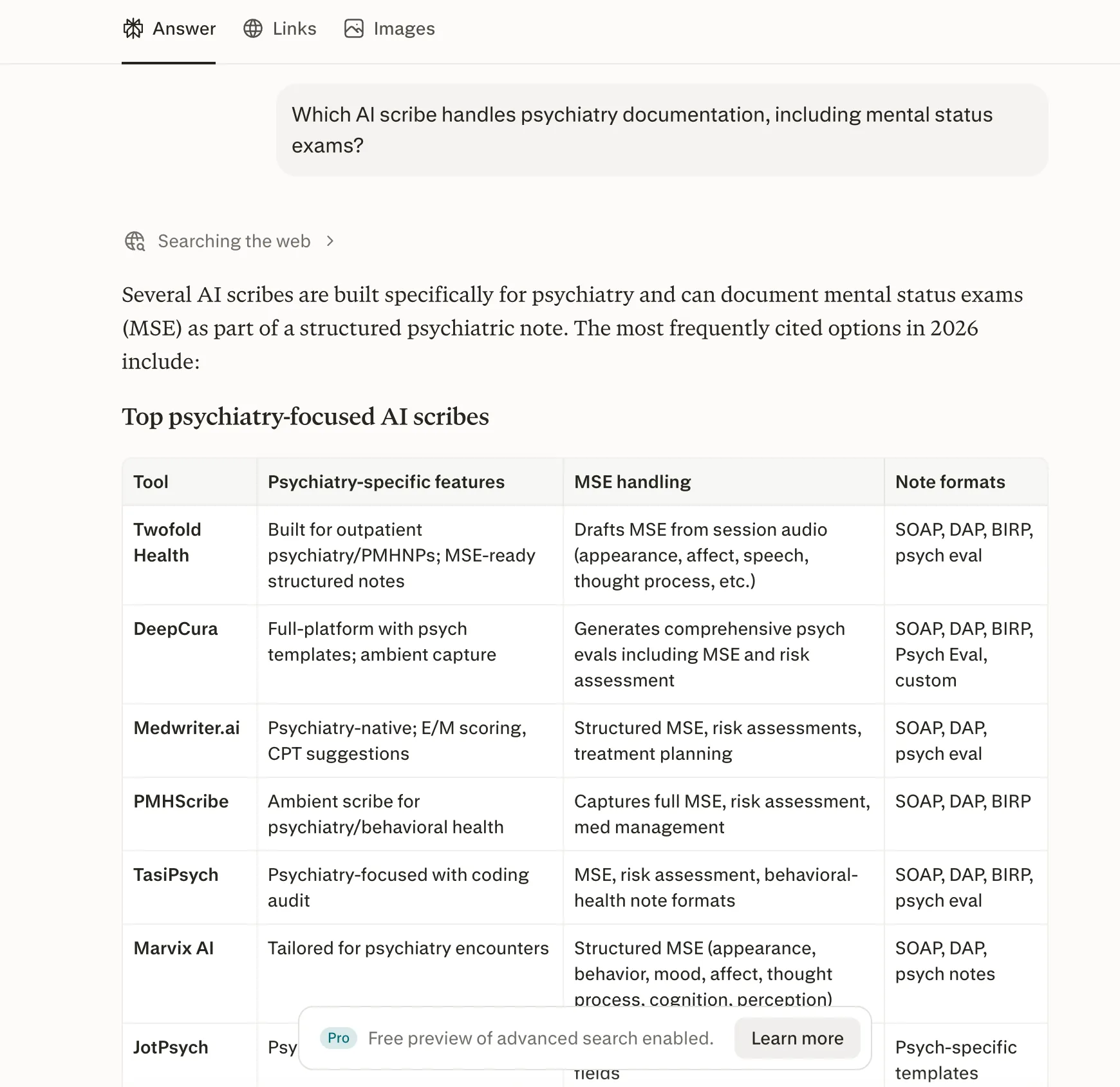
Perplexity
1 / 3
Thirteen different brands take a first position in the original-run table. Six of the nine specialties have no brand common to every platform’s top three. And tools most people in this market rarely discuss — Psynopsis, Dictum, ScribePT, and Upheal — each take a first position in the niche they target. Behavioral health has effectively become its own sub-market, contested by Mentalyc, Upheal, and Twofold instead of the category leaders.
The follow-up psychiatry capture also shows why these positions should be treated as snapshots rather than permanent rankings. Claude’s first-listed tool moved from Psynopsis in the original run to Medwriter in the repeat, while Gemini and Perplexity again opened with DeepCura and Twofold. The specialty pattern persisted; the exact ordering did not.
The evidence layer explains most of it. The most-cited domain across all nine specialty questions is deepcura.com — 18 citations, more than any other site. DeepCura publishes a separate “best AI scribe for X” page for psychiatry, dermatology, orthopedics, physical therapy, and pediatrics, and each gets cited on its matching query. The result: DeepCura is the most-mentioned brand in the whole specialty cluster — 17 of 28 answers. Commure runs the same play.
But I’d be careful before pushing out different specialty pages for your AI Scribe. That’s called programmatic SEO and requires extreme caution as Google has been penalizing poor programmatic SEO attempts.
Two brands show what full ownership looks like. OB/GYN went to Freed on every platform — the only specialty sweep — and Freed maintains a dedicated OB/GYN page plus an FAQ answer for that exact question on its flagship comparison. Oncology put DeepScribe in every platform’s top three, which is what a decade of specialty-specific positioning buys you.
That’s the same mechanic behind the study’s only other consensus results. “AI scribe for SimplePractice” went unanimously to SimplePractice’s own Note Taker. “Free tier” went unanimously to Heidi. Every consensus winner owns one specific, checkable, boring fact — a native integration, a maintained specialty page, a published free tier — that all five platforms can verify and none can dispute. Nobody wins consensus by being best. They win it by being unambiguous about one thing.
Which is why the EHR cluster behaves the way it does, too: wherever an EHR ships a native scribe, that feature dominates its own EHR’s queries (Note Taker, Sunoh, Ambient Assist, ModMed Scribe). Third-party scribes only win EHR queries where no native option exists.
Finding 7: The SEO layer underneath all of this
I want to be upfront: I didn’t measure organic Google search rankings in this study. But I can’t write an honest conclusion without addressing them, because three things in the data point straight at classic SEO.
First, Google’s AI Overviews split by intent. An AI Overview appeared on 12 of my 38 questions. Every open-discovery question triggered one. Four of five practice-size questions did. And then: zero of the eight EHR-integration questions, zero of the five pricing questions. For the intents closest to a purchase decision — does this work with my EHR, what does it actually cost — Google still serves classic blue links.
This is of course, a single run, and you might see a different result. But your ordinary rankings fully govern those queries today, on the platform with the most buyers on it. And not everyone just read off AI Overview and bounces. Clinicians usually do in-depth research, so your traditional rankings play a huge part as well.
Second, the platforms that cite most are the ones reading a search index. Look back at the personality table. AI Overviews synthesize from top-ranking pages. Perplexity and ChatGPT run searches and read results. Claude retrieves. Gemini, which cites roughly one source per answer, is the outlier that leans more on memory.
Third, a small observation from my own audit. When I went to fetch the 20 most-cited pages, I found all of them immediately by searching their target query — they were ranking, albeit some higher than others. Among the pages least cited/mentioned, companies like Wavo Health’s and River Records, slightly lower on SEO rankings were also lower in AI models. That’s a small sample and an informal test, so I’d call it a hint rather than a finding. But the direction matches what marketing folks keep reporting — that ranking well and getting cited often travel together.
So the honest framing for anyone budgeting against this: AI visibility in this category doesn’t look like a separate channel with separate mechanics. It looks like a layer sitting on top of search, with an additional entity-strength filter that decides who gets recommended once your page is in the retrieved set. I’m planning my next study around testing this properly — SERP positions and off-site brand coverage for these same URLs, checked against citation frequency. Until then, please do not subside GEO as “just SEO”. It’s a bit different than SEO.
Finding 8: Compliance questions are an empty room
Six questions covered trust: HIPAA, BAAs, patient consent, data retention, whether recordings train the models.
These produced the strangest answers in the study. Vendor mentions collapsed — only 10 of the 18 full-text answers in the cluster named any vendor at all, and two questions produced minimal brand names on multiple platforms. Into the vacuum, the engines pulled whoever had published something substantive: a few law firm’s healthcare-AI compliance explainers got cited. So did two vendor trust centers, trust.abridge.com and trust.nabla.com — which tells you trust subdomains are fully citable when they exist.
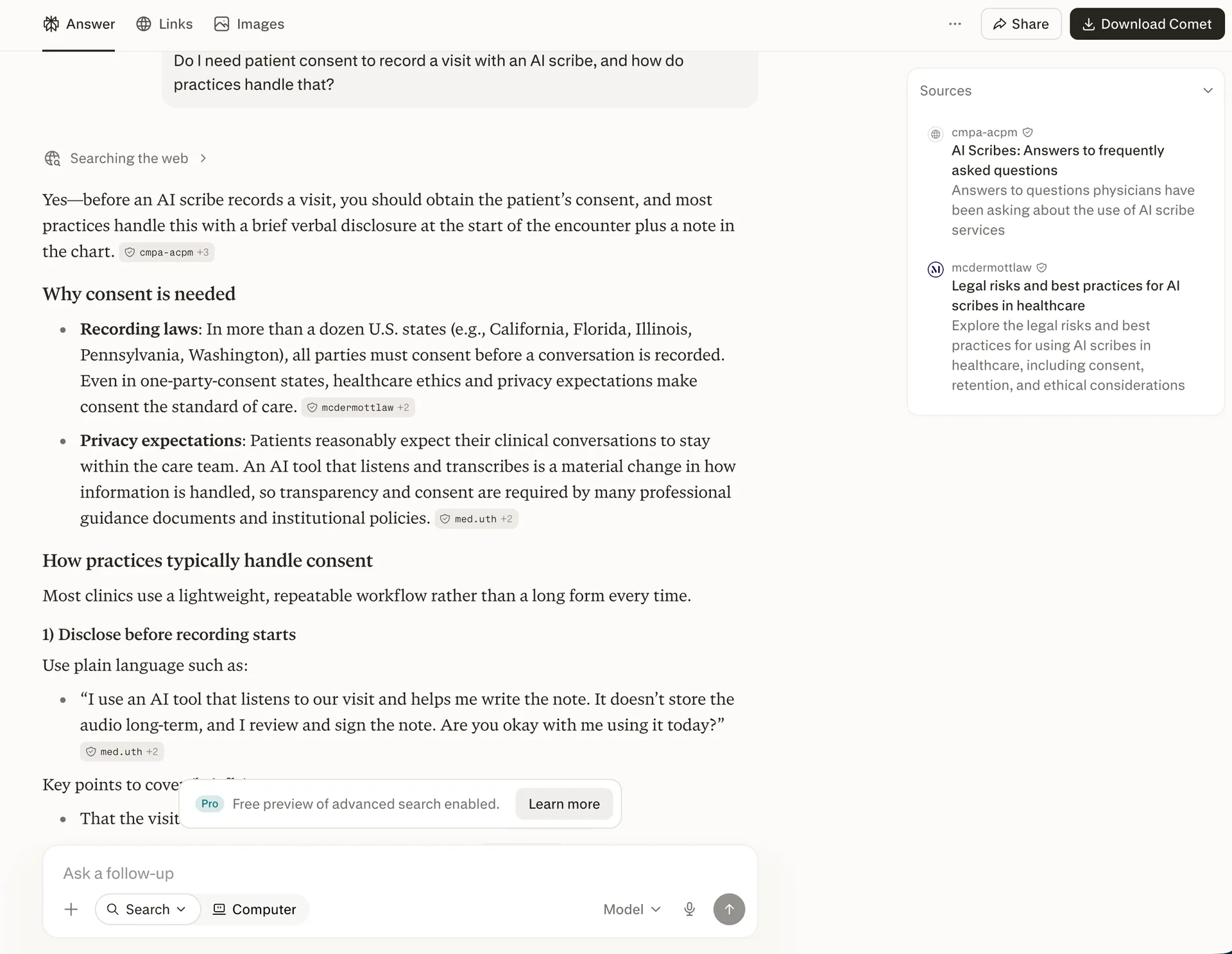
Perplexity
Think about who’s asking. A practice manager asking “do AI scribes need patient consent in California” is deep in an evaluation, well past the shortlist stage. And almost no vendor is in that conversation.
Freed is the partial exception: its security page and HIPAA explainer both appear in the citation data, and its how-to content includes an actual patient-consent script a physician can read aloud. That’s the specificity this cluster rewards, and nearly nobody is competing for it.
Of everything in this study, this is what I’d act on first as a challenger. Every other cluster asks you to out-publish 45 competitors. This one is nearly empty.
What I’d try first if I wanted to increase the AI search visibility of an AI scribe company
If you’re cited but not recommended (Findings 4 and 5): your retrieval works and your entity doesn’t — and Finding 4 is the invoice — 64 answers built on your group’s content, a memory brand in the top three of 84% of them. Rewrite the self-positioning inside your own comparison content, because several companies on that list rank themselves so modestly that the engines take them at their word. Build corroboration off your own domain, since a model recommends brands it can verify in more than one place and right now many of you exist only on your own blog. Then pick one intent — one specialty, one EHR, one price point — and own it, because Finding 6 shows that’s where small brands actually get recommended.
If you’re mentioned but never cited (DAX, Abridge, Suki, Nabla, Ambience): your visibility runs mostly on training memory while 45 challengers write the evidence layer under you. These are often bigger brands who don’t rely on organic search or GEO, but posting content around your product can make the AI model’s wording for your product consistent, which it isn’t right now. A named-rival comparison may be off the table for legal or procurement reasons; a pricing-structure explainer, a rigorous buyer’s guide, and a public trust center usually aren’t, and all three formats get cited in this data. Abridge’s and Nabla’s trust subdomains are proof the partial version already works.
If you’re a specialty product: Finding 6 is your strategy memo. One page per specialty, written around the visit type, and you can take first slots from category leaders on individual platforms this quarter. But with extreme caution. You definitely don’t want Google coming after you for scaling near-identical pages. Also, it’s a complex process. Definitely recommend getting someone who know what they’re doing.
And for everyone else: claim a piece of the trust cluster. A real trust center on its own subdomain, a consent-script page, a plain-language retention explainer. Your competition there is a law firm. Lots of other smaller wins too. But this would be a start. More on this in my upcoming content.
One caution on all of the above. Everything in this study describes this run, on these platforms, in a category where the evidence layer is unusually thin and unusually self-published. The tactics that work here work because 45 vendors got to the listicle slot before anyone independent did. That won’t hold forever.
Improve your Google and AI Search visibility
If you’re at an AI scribe company and you’ve read this far, you’ve probably been scanning for your own name. For a more in-dpeth analysis, feel free to send me your domain and I’ll analyze your Google SEO and AI search visibility — which buyer questions you come up for in Google and in AI answers, who comes up instead of you, and which sources those answers get built from. Also, a few recommendations.
I do it myself, so please allow a couple of working days. If the snapshot is useful, maybe I earn your business, and we work on increasing your number of leads through Google and AI. If not, feel free to use it yourself.
Limitations and method
Method. 38 prompts across six intent clusters, run on ChatGPT, Claude, Gemini, Perplexity, and Google AI Overviews via a capture extension, producing 190 answer records with full text and citation metadata. Chat user interface used just like normal buyers, no API. Analysis: brand-alias normalization across ~68 vendors, domain-ownership mapping, page-type classification, and removal of conflicting capture artifacts. For every vendor, I cross-referenced the answers citing their domain against the brands those answers named. I also audited the 20 most-cited pages against 13 on-page traits and checked robots.txt and llms.txt for the five largest never-cited brands.
Limitations. One run, one day per platform; AI answers vary between sessions, so expect counts to wobble on a re-run and the structural patterns to hold. Mention counting used a hand-built alias dictionary of ~68 vendors; smaller brands outside it were matched by domain name, which is cruder. The page audit is a winner-only sample with no matched set of uncited pages, so it describes what cited pages have and can’t prove any trait caused citation — and it covers on-page factors only, with SERP position and off-site coverage unmeasured, as discussed in Finding 7. Page copy and prices change; everything was captured on the dates stated in the data files.
If you spot an error — a misclassified domain, a product I’ve mischaracterized — tell me and I’ll correct it.