
Research · 5 AI search systems · August 2026
Who AI Recommends in the AI Front Desk Category — and Why It Isn't the Companies Publishing the Most
I ran 30 buyer questions about AI receptionists, AI voice agents and AI patient contact centers across five AI platforms. 150 answers, 1,108 citations. Here's what separated the brands the AI recommended from the brands it merely used as evidence.

Three weeks ago I published a study of the AI scribe category that found something interesting: the companies publishing the most comparison content were getting cited constantly and almost never recommended. AI models would use their pages to fetch content but often recommend their direct competitors.
I wanted to know whether that was a quirk of one category, or how this actually works. So I ran the same study on AI front desk — receptionists, voice agents, patient contact centers — a category that is younger, noisier, and apparently nowhere near settled.
It replicated. But I found some more useful findings underneath it.
In 46% of the cases where an AI put a brand on a shortlist, the answer never cited that brand’s website at all. Nearly half of the recommendation layer in this category is running on evidence the vendor doesn’t own and can’t see in their analytics.
Which means it is still open season in those categories.
And most AI visibility strategies and tools are not built for this type of thing. And it explains almost every strange result in this dataset, including why a company can publish the most-cited page in its category and watch a competitor collect the recommendations.
Here is what I think is actually going on, what it costs the companies on the wrong side of it, and where the open ground is while this category is still developing, at least in AI answers, that is.
The short version
- Nobody has won this category yet. Across 15 shortlist questions, not one produced the same top recommendation on all five platforms. 14 of 15 had no brand common to every platform’s top three. In AI scribes, at least a leader existed. Here the leaderboard is still being written, which is also an opportunity for brands to claim visibility now, when it’s cheaper than it will ever be again.
- Publishing volume is not the lever people think it is. The most-cited vendor domain in the study fed 17 answers and was the recommendation in 3. Across every answer built on a vendor-owned comparison page, the publisher was the opening recommendation 24% of the time.
- The brands that win are the ones the market explains consistently — same category, same customer, same proof, repeated on sites they don’t own (note that some of those can be controlled. It is pay to play to some extent).
- A third of buyer questions returned no vendor at all. 53 of 150 answers mentioned nobody. That is the cheapest ground in the category and almost nobody is standing on it.
Your content is doing a job. It just may not be your job.
For every vendor in the study, I pulled the answers that cited that vendor’s own website, then checked what happened to the vendor inside those same answers. Cited, mentioned, recommended — three separate events.
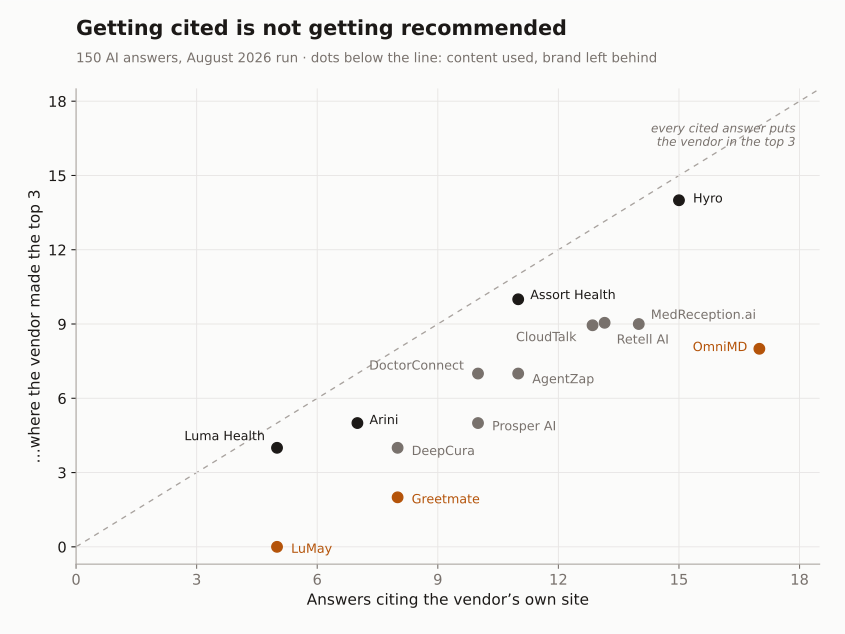
Dots on the diagonal convert citations into recommendations. Dots well below it are supplying evidence for somebody else’s.
The aggregate: 46 answers in this study cited at least one vendor-owned comparison page. The publisher of that page was the opening recommendation in 11 of them. The other 76% of the time, their content helped the AI recommend a competitor. The single biggest beneficiary was Luma Health, which opened six of those 46 answers while publishing almost no comparison content itself.
Three cases to show the range:
OmniMD wrote the most-cited page in the category. One URL — its “Top 10 AI Medical Receptionist Companies” post — accounts for 25 of its 28 citations and made omnimd.com the most-cited vendor domain in the study. Across the 17 answers built on it, the opening recommendation went to Assort Health three times, OmniMD three times, Luma Health twice, DoctorConnect twice, and a long tail after that.
Readers of my scribe study will recognize the company: there its comparison page was also the most-cited in the category, and OmniMD was recommended first zero times. One thing changed between the two pages. The scribe listicle ranked OmniMD sixth on its own list and opened by pointing readers to competitors.
The front-desk page positions OmniMD as the #1 pick for practices that want a complete AI front desk working with any EHR. Zero recommendations became three. I can’t call that causal from a single run — all three came on one platform — but it’s consistent with what I found last time: the engines sometimes largely take your own page’s framing of you at face value. If your comparison page is modest about you, so is the answer built on it.
CloudTalk published more cited comparison content than anyone else here — 23 comparison-style citations, cited in 13 answers, the opening recommendation in two. When the answers do mention it, they say some version of the same thing: capable phone platform, not medical-specific. The content earns retrieval across the whole category. The brand identity doesn’t match the healthcare constraints in the questions, so the recommendation moves to a brand that does.
LuMay is the clean version. Its comparison pages were cited in five answers. It made the top three in none of them and went unmentioned in three.
None of this means the content failed. Citations are real retrieval wins and they’re the entry ticket — every brand in the top half of that chart is publishing too. But if comparison content is the core of your AI visibility plan, the question to put to whoever runs it is the one from my last study, which this data makes harder to dodge: when our pages get cited, who gets recommended?
To get recommended by AI, your brand identity must be echoed across the web
Now the other side. A handful of brands convert citations into recommendations at a higher rate, and several get recommended in answers that never cite them at all. When you read what the AI actually says about each one across 150 answers, the same thing keeps showing up, and it isn’t a content volume story.
Hyro was cited in 15 answers and made the top three in 14 — the best conversion in the study — plus all five enterprise answers. The answers don’t describe its features. They recite its customers: “its customers include major health systems like Intermountain Health, Montefiore Health System, and Hartford HealthCare.”
I traced where that comes from. Fierce Healthcare, MobiHealthNews, PR Newswire and the American Hospital Association all covered Hyro’s Tampa General deployment, and that coverage reports the health system chose Hyro for its healthcare-exclusive focus and deep Epic interoperability. That is nearly word-for-word the reasoning AI answers now use to recommend Hyro. The market wrote the pitch. The models repeat it.
Assort Health was the opening recommendation more often than any other brand in the study, and in all 11 answers that cited its site, it was mentioned. One consistent phrase was doing most of the work: the platform for established specialty practices with complex scheduling. That claim is corroborated off its domain — one of its health-center customers announced the deployment on the customer’s own website, naming Assort as the technology. When a platform builds a “best for” table, Assort’s cell is already written.
Luma Health is the most instructive. Mentioned in 25 answers. Its own website cited in five. 83% of its shortlist appearances happened in answers with no lumahealth.io citation anywhere. Years of EHR-adjacent market presence carry it entirely. Sully.ai shows the same profile in miniature and concentrated on one platform: mentioned 12 times, own site cited three, half its mentions on Claude alone.
Arini did it through a specialty vertical. Mentioned in 9 of 10 dental answers — the closest thing to a sweep anywhere in this study — with the platforms volunteering its integrations unprompted: natively connects to Open Dental, Dentrix, Eaglesoft. Off its domain, the identity is just as narrow: a Y Combinator launch story about founders who shadowed dental practices, dental podcasts, DSO content. It never tried to win “AI receptionist.” It saturated dental until the brand and the vertical stopped being separable.
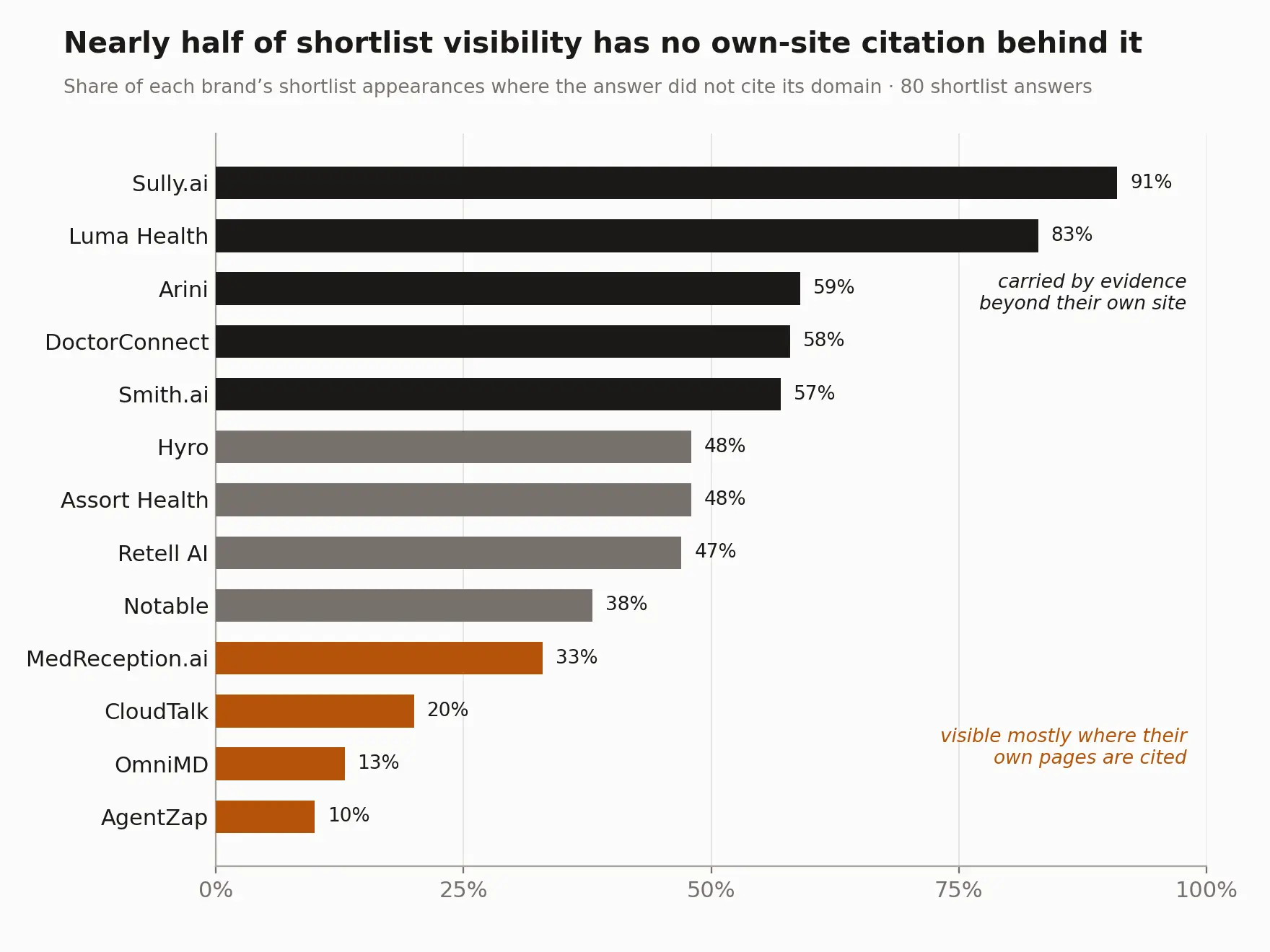
AI systems recommend the brands whose category, customer, capability and proof are described the same way in many places at once — the company’s own site, customer announcements, trade coverage, ecosystem pages. I call it corroborated entity coverage.
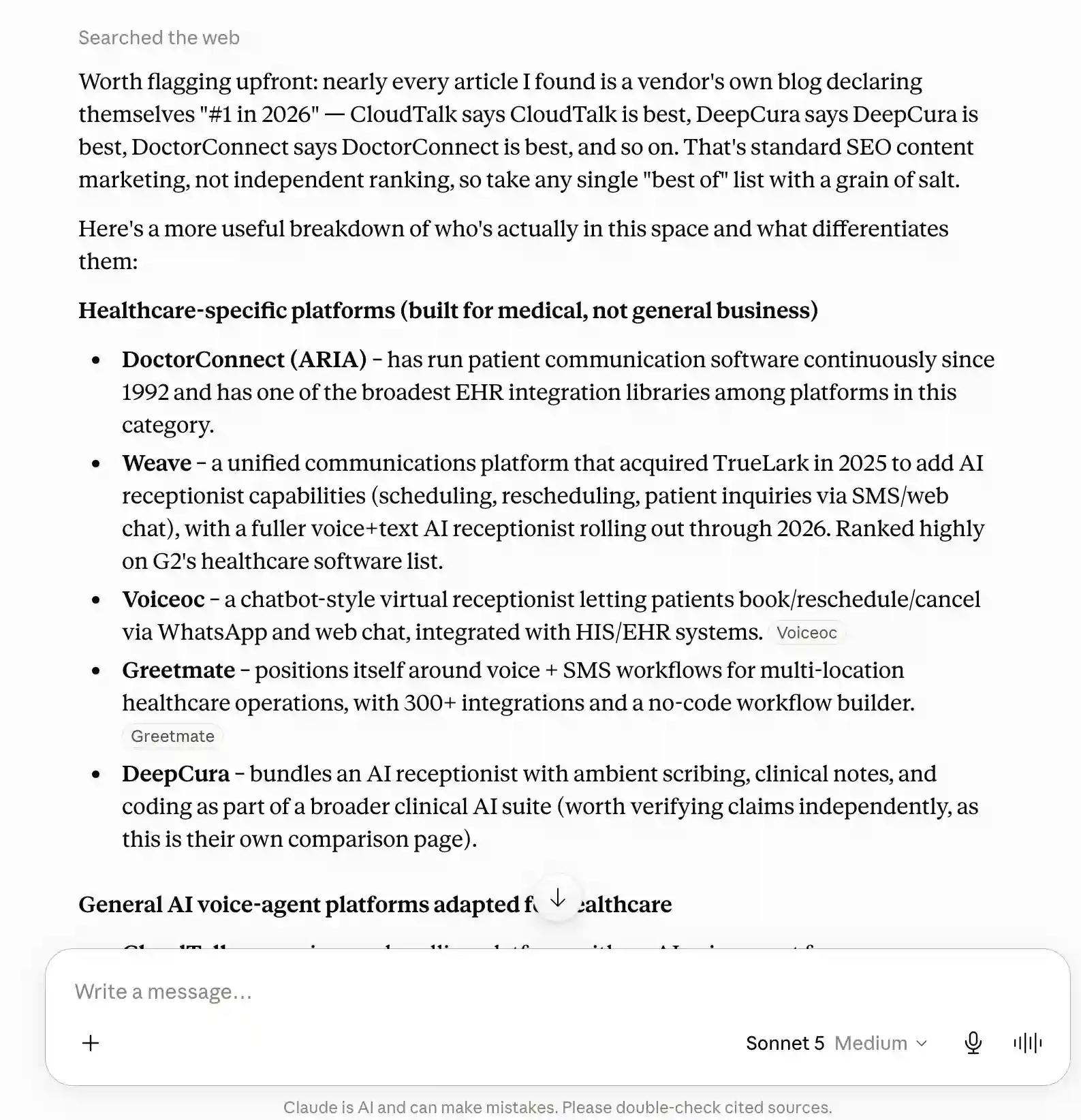
When the same identity comes back regardless of which sources a platform happens to retrieve, the model has something stable to recommend. When it only exists on your blog, the model has a page, one instance with enough awareness that this might be heavily biased (Claude literally opened its answers saying this).
Content creates your claims. Consistent corroboration outside your domain is what makes them stick, and it’s the half of the game an owned-content strategy never touches.
Which of these four is your company?
Every brand in this study sits in one of four positions. The intervention is different for each, which is exactly why a single blended “AI visibility score” is worse than useless — it averages away the only diagnostic information you have.
- Cited but rarely recommended — OmniMD, CloudTalk, LuMay, Greetmate. Retrieval works, identity doesn’t. Two things to check: how your own comparison pages position you, since the engines take that framing largely at face value, except for Claude. I’m not talking about crowning yourself number 1. I’m talking about what features/pain points you associate your product with in that content. And whether anything beyond your domain confirms your category, customer and proof. Several companies in this group exist almost nowhere except their own blogs.
- Recommended but rarely cited — Luma Health, Sully.ai, Smith.ai. Visibility runs on market memory. It’s a strong position but also a fragile one: you can’t steer it, segment it by buyer intent, or defend it when a challenger’s page becomes the retrieved evidence on the question that matters. More blog posts won’t fix it. Try other forms of citable proof such as integration documentation, a real trust page (look at trust.abridge.com), customer results with methodology, so the retrieval layer has something of yours to hold.
- Strong on one AI platform. MedReception.ai took 8 of its 18 mentions on Google AI Overviews. Prosper AI took 6 of 11 on Gemini. Sully.ai, half on Claude. Notable is absent from Google entirely. That concentration is a diagnostic, not a moat, and it’s invisible to any team checking a single platform.
- Winning a narrow definition — Arini in dental, Retell AI among developer-built deployments. The most defensible position in an unsettled category, and the one most likely to get abandoned too early in favor of the generic category page.
Worth knowing before you pick a lane: the category noun itself hasn’t converged. “AI medical receptionist” returned 18 brands, tilted toward practice-level front-desk tools. “AI voice agent” returned 20, tilted toward infrastructure and enterprise conversational AI.
Only five brands appeared in both. Ask about a patient contact center for a large physician group and Genesys, Five9 and Talkdesk walk in while the practice tools disappear. One run can’t prove wording alone causes that. It’s enough for me to say I wouldn’t architect a site here around one canonical category page.
A third of buyer questions have no vendor in the room
The most actionable thing in this dataset is the absence of a leaderboard in a lot of answers. 53 of 150 answers mentioned no vendor at all, and they cluster in three places.
The trust cluster. Behavioral health and urgent-care safety questions: zero vendors across all ten answers — the platforms pivot to crisis routing, 988/911 and human escalation. General HIPAA, recording consent, AI disclosure, what happens when the AI gets something wrong: four or five vendor-free answers out of five, each.
One pair of questions shows precisely where this turns commercial. “Are AI medical receptionists HIPAA compliant?” produced zero vendor mentions on every platform. “Which vendors are HIPAA compliant and will sign a BAA?” produced vendor lists on all five — MedReception.ai and AgentZap on four platforms each.
One clause about a BAA converts an educational answer into a procurement shortlist, and the brands showing up are simply the ones whose pages state BAA availability plainly.
The “whether” cluster. This is the one I didn’t see in the scribe category and the one I’d act on first. The questions buyers ask before choosing a vendor — healthcare-specific tool or general voice platform, are these actually good enough yet, AI receptionist versus answering service versus another hire, is it really cheaper — were almost entirely vendor-free. On the receptionist-versus-answering-service-versus-hire question, four of five platforms mentioned no company at all. Every vendor’s blog claims to answer these. Almost none is present when an AI does.
The capability boundary. Asked whether an AI receptionist can verify insurance eligibility or handle prior authorization, four of five platforms declined to name anyone and explained the eligibility-versus-prior-auth boundary instead. Plenty of vendors claim “insurance automation.” The public evidence apparently doesn’t let a model work out who does which part of it. There’s your opening.
There’s another common thread though. Across the 723 answer-linked citations, roughly nine in ten point to pages owned by vendors or other commercial software companies. Government sources, almost entirely HHS, on compliance questions — are about 4%.
Independent editorial coverage: three citations. Academic: zero. And G2, Capterra, KLAS, Software Advice and Trustpilot were cited a combined zero times across all 1,108 placements, though the ratings still leak in secondhand — Claude quoted a dental vendor’s “4.6/5 rating across 400+ G2 reviews” without citing G2.
The independent layer buyers assume exists in a clinical software category does not exist inside these answers. Vendors are writing the evidence. In the empty rooms, nobody is.
What I’d do if I wanted to appear more in AI Answers
The honest headline is that this category has no incumbent yet, and the mechanism deciding who becomes one is visible in the data: consistent, corroborated identity beats publishing volume. That’s a window for now, and unconsolidated categories don’t stay unconsolidated for too long.
If I had one quarter and a budget, I would spend it in this order: find out which of the four positions above I’m in, since the wrong intervention is expensive and slow; make sure the claims I want repeated actually exist somewhere I don’t own — a customer’s announcement, an ecosystem page, a piece of trade coverage that states my category and my proof the way I’d state it myself; and take one empty room, most likely the whether-stage questions, where a well-made answer competes against almost nobody.
What I wouldn’t do is fund another round of comparison pages and call it an AI visibility strategy. Not because the format fails — it earns citations reliably — but because this study now shows twice, in two categories, what those citations do when the identity underneath them isn’t strong enough to convert those citations into recommendations, which is what you want, more people buying your product.
One caution, same as last time: everything here describes this run, on these platforms, in a category where the evidence layer is unusually vendor-authored. Those conditions won’t hold forever, and in a market this unsettled they’ll change faster than they did in AI scribes.
See where you stand in organic and AI search
If you’re at an AI front desk or healthcare voice AI company and you’ve been scanning this for your own name, send me your domain. I’ll check which buyer questions you show up for in Google and in AI answers, who shows up instead of you, and which sources those answers are built from — plus what I’d try first. If it’s useful, maybe I earn your business. If not, use it yourself.
Method and limitations
Method. 30 buyer questions spanning discovery, practice versus enterprise, scheduling depth, EHR integration, specialties, pricing, proof and trust, run on ChatGPT, Claude, Gemini, Perplexity and Google AI Overviews through a capture extension, in the chat interfaces buyers actually use, no API. 150 answer records with full text and citation metadata; 1,108 citation placements, of which 723 were tied to the generated answers after separating Google’s side-panel source cards. Analysis: brand normalization across 60+ vendors with citation labels stripped from answer text before counting mentions, domain-ownership mapping, comparison-page classification, and a cited-versus-recommended trace for every vendor domain. “Top three” means the first three brands mentioned in an answer. Every figure quoted above was hand-checked against the captured answers.
Limitations. One run, one day. AI answers vary between sessions, so expect counts to move on a re-run and the structural patterns to hold. ChatGPT groups some citations behind expandable chips that don’t always resolve, so its citation counts are a floor. “Top three” is a position measure, not human coding of recommendation strength; I corrected the cases where a brand appeared only inside a caveat. Gemini answered the ROI question in Australian dollars despite US settings — one reason I quote no pricing figures from this study as market data. Brand counting used an alias dictionary of 60+ vendors; smaller brands outside it were matched by domain, which is cruder. Nothing here measures product quality, market share, or causation — only what five AI systems said on 16 August 2026.
If you spot an error — a misclassified domain, a product I’ve mischaracterized — tell me and I’ll correct it.